| « Sleeping Is Giving In | The Great Porteño Smokeout » |
From a Buenos Aires travel guide:
Take a beginner's tango lesson at 9 and then stay on to dance the night away at the 10:30 milonga. Get swept away in the arms of Buenos Aires' finest dancers - and lose yourself in the magic that is authentic Argentine tango!
A few weeks ago I walked into a tango studio that I had been passing daily, just down the block from my apartment. San Telmo is a tango-rich environment and there are many studios advertising instruction, but this one seemed the most accessible for someone with social anxiety. There were no buzzers to ring, stairs to climb, or windowless doors to knock on. Instead, lessons seemed to take place at the far end of a dingy covered arcade, with a clear exit path to the street in case of trouble. One Saturday afternoon I braved the long, intimidating walk, footsteps echoing all the way down to the end of the corridor, where geometric figures were painted in white on a shiny green dance floor. A small, immaculately-dressed elderly man greeted me, positioned me in the middle of the dance floor, placed a pretty Dutch tourist in my arms and said "you are the captain!"
And so my first impression of tango was positive.
Before coming to Argentina the only kind of tango I had seen was the overwrought, fishnets-and-brylcreem variety full of smoldering glances, bad hats, legs being wrapped around torsos and a 73:1 fabric ratio between the man's costume and that of his partner. So it was a pleasant surprise to find that tango in Argentina (except for the stage displays) is a much subtler and more elegant dance. Couples tango on a crowded dance floor in a very close embrace that leaves their upper bodies almost motionless, and the dance itself is improvised and highly individual. The result is something that looks like the top half of a hug grafted onto a Fred Astaire number.
Take our quick primer in introductory jazz trombone, then get ready to jam through a festive night of bebop, Dixieland and free-form melodic exploration with one of Chicago's finest jazz ensembles!
After I had spent a few minutes attempting to move the Dutch woman in rectangles, Armandito's fellow instructor Mónica glided over to have a look. She pried the poor woman from my grip and then stood in front of me in mute reproach, trying to reposition my feet, hands and trunk while all the while shaking her head and mouthing the word "no".
After about a minute of this silent adjustment I said, "I'm sorry, I don't think I understand what you want me to do."
"You speak Spanish?"
"Yes."
"Oh thank God!"
And from then on I had found my niche. No matter how poorly I might dance, I could always step in and translate for the English-speaking students who often came to group lessons. For some reason many of them were more interested in ordering tango shoes (a side business Mónica runs) than learning anything about how to use them.
“Marcel, ask this one why he is walking like a wounded hippopotamus.”
“Do you see this bunion on the first outside knuckle of my left big toe? They will need to make it just a touch wider there. Tell her this is important. Hola, señorita, this is very important.”
Armandito, a lion of the dance floor, turned out to be eighty years old. This does not prevent him from performing all manner of spins, twists and bends with Mónica, or from moving as gracefully as a cat when he is demonstrating a step to his students. Further supporting the theory that sixty years of dancing tango have rendered Armandito indestructible is a collection of press clippings on the studio's cork board. They detail how a giant chandelier fell on his head as he was dancing one afternoon four years ago at a ritzy tango parlor called the Confiteria Ideal. A true gentleman, Armandito absorbed the entire force of this blow himself, leaving his partner untouched and anonymous. And after a few hours of observation and some stitches, he was released back into the wild.
Stop in for a quick prep course in conversational Swedish and then get ready for a night of riotous repartee, debate, and laughter with Stockholm's literati as you discuss the latest currents in contemporary Scandinavian prose.
Tango has a similar trajectory to the American Delta blues. It arose out of black culture (back when there was a sizable black population in Buenos Aires), developed locally, crossed overseas, and then remained forgotten in its homeland for many years until a younger generation of Argentines took an interest in learning from the still-living masters and sparked a big revival. Now there is both a thriving local dance scene and an enormous tourism industry built around tango, including large numbers of foreign dancers who take their first trip here with all the reverence of a pious Muslim making a late-life pilgrimage to Mecca. You can identify some of these tango hajjis in the dance halls because they dance beautifully and yet don't speak much Spanish, standing awkwardly during the first moments of each song that other couples use as an opportunity to chat.
People dance tango at a structured event called a milonga (the word can also apply to the dance hall itself, or to a two-beat older form of tango music), the only social setting in Argentina where you must fetch your own drinks and empanadas at a bar rather than waiting for table service. The host seats guests around the dance floor based on his guess at their dancing skill and other intangible factors (such as how great they look). Men ask women to dance by trying to make eye contact and nodding towards the dance floor in a gesture called the cabeceo. In theory this is a discreet way for men to save face in the event of a refusal; in practice it means men cross the darkened room, stand three steps in front of their intended partner, and wag their head gravely until she either gets up to dance or tells them to go away.
Each tango song is about three minutes long, and in a milonga these come in sets (called tandas ) of three or four songs of similar style. It is considered a big diss to abandon a partner in the middle of a tanda, so if you ask someone to dance at the start of a set you are on the hook for twelve to fifteen minutes of tango. Many dancers who are not ready for that level of committment wait until the second or third song to go out on the floor, creating a paradox for the beginner: the floor is much easier to navigate at the start of a set, but you are far less likely to find someone willing to put up with you for a full four songs.
At the end of a tanda the DJ plays a short piece of music called a cortina, which is meant to be a completely undanceable signal for dancers to clear the floor. There is much hand-wringing in American tango blogs over the proper choice of music for this snippet — how do you make the music unambiguous without spoiling the magic, soft-focus, adult-contemporary mood of the milonga? Do you put on Mozart? Do you put on Schubert? DJs in Buenos Aires cut the Gordian knot by putting on Creedence Clearwater Revival and watching as the ebb tide of tango dancers collides with a rush of delighted couples racing to dance thirty seconds of lindy hop before the tango axe falls again.
Arrive early for a "crash" course in track handling and a practice lap at the Indianapolis Motor Speedway, then join the excitement of authentic Formula 1 racing at one of America's most hallowed racetracks!
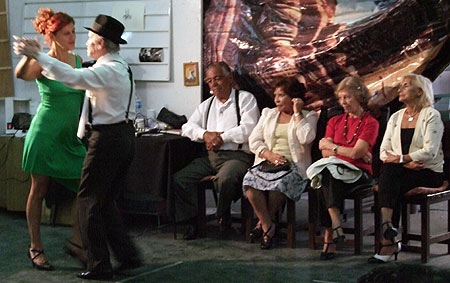
On Sundays the studio puts on a tango show. Armandito arrives dressed in an immaculate white shirt and broad white neckcloth embroidered with a black tango shoe, and optimistically sets out four rows of plastic seats in the middle distance. Luciano the tango singer comes to provide live music. Luciano is a barrel of a man with slicked-back hair and the kind of thunderous voice that can peel paint from furniture. He approaches each song as a matador might approach a bull. He starts his set with microphone in hand, but during the many crescendos he gradually moves the microphone away from his face, which has the paradoxical effect of making him louder. The microphone, it turns out, is acting as a physical barrier to the full impact of his voice, de-amplifying it into a quieter, more distorted sound.
While Luciano sings Armandito flits through the audience like a hummingbird, selecting tango partners. In his embrace both elderly Argentine ladies and nervous Canadian tourists transform into lovely figures of elegance for the three minutes it takes Luciano to drive a sword through the heart of another sentimental favorite.
Once the singing has ended, Armandito greets anyone still remaining and gives his introduction to the tango, recounting the origins of the dance and making sure to stress a Harvard study that has found it is an effective therapy for people with Parkinson's. Personally, I would just say “I am eighty years old and four years ago a chandelier fell on my head", but I do not wish to second-guess my teacher. Then he and Mónica perform a lovely set of dances, the chairs are cleared, and the remaining die-hards stay for a short milonga.
Build your scalpel savvy at the Mayo clinic's afternoon neurosurgery boot camp; then slip into some sterile blues and get ready to assist a crack team of pediatric surgeons with a delicate procedure on some of the cutest patients you'll ever meet!
There is a group of Argentine ladies of a certain age who come every week to the tango show, and between them they graciously accept the responsibility of dancing with me. The job of a tango leader (in Argentina invariably the male role in a mixed couple) is not an easy one to master. The leader has to keep time, navigate the dance floor, avoid collisions, lead the steps, pay attention to what the follower is doing, and at some point notice that the music has stopped, the lights have been turned off, and the follower would like to go home. Like prisoners who have learned to communicate through a laborious system of clandestine taps and knocks on the wall, tango dancers must signal one other entirely through minute, Cabalistic movements of the torso, the one part of the body that does not appear to move at all. Loudly whispering “quarter turn to your left in three... two... one...” is considered bad form.
Each week I brute force my way through a dance with these gracious partners, and each week they are quick to assure me it wasn't nearly as much of a Calvary for them as it had been the week before. As one of them said to me sweetly after what I thought was a rare successfully-executed figure, "Don't worry. Someday you will know what you are doing."
A Partial List of Tango Mistakes I Have Made
- Torso too far forward
- Torso too far back
- Torso technically straight but still just wrong somehow
- Shoulders hunched forward
- Shoulders arched back
- Bouncing while in motion
- Weird panther-like shuffle that kept head unnaturally level
- Knees not bent
- Knees bent too far
- Moved without waiting for partner
- Wrong-footed partner
- Instead of taking smooth steps with the sole of foot gliding along the floor, staggered like Frankenstein monster
- Somehow ended up with partner many meters from dance floor, in construction area in the back of the studio
- Ran partner into table
- Ran partner into mirror
- Ran partner into other dancers
- Ran partner into wall
- Tipped partner over
- Kicked partner in toes
- Kicked partner in side of foot
- Kicked partner in shin
- Stepped on partner's foot
- Walked directly into partner
- Inadvertently dipped partner
- Struck partner in teeth with shoulder
- Left arm too limp
- Left arm too stiff
- Left arm pumping furiously in air for balance
- Right arm insufficiently firm (the correct position for the man's right arm in tango is wrapped just far enough around the woman's back that you feel she is about to file a lawsuit)
- Arms moved independently of torso
- Looked at feet while dancing
- Failed to listen to music
- Did not appear relaxed
| « Sleeping Is Giving In | The Great Porteño Smokeout » |
brevity is for the weak
Greatest Hits
The Alameda-Weehawken Burrito TunnelThe story of America's most awesome infrastructure project.
Argentina on Two Steaks A Day
Eating the happiest cows in the world
Scott and Scurvy
Why did 19th century explorers forget the simple cure for scurvy?
No Evidence of Disease
A cancer story with an unfortunate complication.
Controlled Tango Into Terrain
Trying to learn how to dance in Argentina
Dabblers and Blowhards
Calling out Paul Graham for a silly essay about painting
Attacked By Thugs
Warsaw police hijinks
Dating Without Kundera
Practical alternatives to the Slavic Dave Matthews
A Rocket To Nowhere
A Space Shuttle rant
Best Practices For Time Travelers
The story of John Titor, visitor from the future
100 Years Of Turbulence
The Wright Brothers and the harmful effects of patent law
Every Damn Thing
Your Host
Maciej Cegłowski
maciej @ ceglowski.com
Threat
Please ask permission before reprinting full-text posts or I will crush you.