| << October 2003 | ^ 2003 | December 2003 >> |
I knew that those troublemaker sunspots were rotating back into view this week, but I was still afraid to get my hopes up too high. The gate agent saw the geeky glint in my eye and was kind enough to reassign me to a window seat on the northern side of the plane. I was going to try to see the aurora.
My last image of America was a silent television channel showing images of Michael Jackson and saying something about an arrest warrant. I thought to myself "boy am I glad I don't have to deal with this". I was heading to Iceland, and I estimated the chances of Bjork being put on trial for child molestation as nil. It was one of many reasons I was glad to be leaving the country.
What finally convinced me to make this journey (which I cannot really afford) was this prospect of spending nine hours in Iceland on a layover. I figured I could get off the early morning plane, ride into Reykjavik, and be back in time for my afternoon flight to Amsterdam. I had always wanted to visit Iceland, but since it comes right after Japan on the list of most expensive tourist destinations, I figured I would never get to go. Now I had the perfect chance to conduct a surgical tourism strike - in and out before the authorities would have time to attach the suction hose to my wallet.
It was a spectacularly clear night over New England, the kind where you can see every city and major road as a little string of interconnected lights, intricate and beautiful. Down on the ground, it's all WalMarts, Kwik Stops and cars blocked in traffic, but from twenty thousand feet it looks like jewelry.
I got my aurorae. The light shows started somewhere past Labrador. I had seen the northern lights from a plane once before (flying home from Cincinatti), but then they were only the faintest glow over the northern horizon. The only way I recognized them was because they slowly changed shape over time, with an occasional rapid flickering, like a computer screen filmed by a TV camera. These lights were unmistakable. There was a distinct green ribbon snaking from west to east, and though my mind knew that it had to be a hundred miles above us, a trick of perspective made it look like it was at the same altitude as the plane. As I watched, the ribbon intensified and diminished - parts of it growing so bright they began to show colors, and then dimming back down again. Above the ribbon were long streamers of green light, whizzing around.
Like an idiot I ignored the spectacle to eat my dinner, and of course it was gone when I went to look again. It stayed gone for an hour or so, but as we crossed Greenland the ribbon came back, much brighter this time, and with two of its friends. They looked for all the world like they were above, below, and at the same height as the plane, and all three were wriggling intensely. Big snakes playing in the sky. The people in front of me were huddled at their window, too, which made me happy. The plane jumped around and shuddered, but I had found the cure for turbulence.
Iceland is disturbingly new. I don't mean that the buildings and habitations are disturbingly new, although there is not much that survives from before the nineteenth century, but rather that the land itself, the stuff you walk on, doesn't have a good track record of just lying around and being there. My own corner of Vermont is built from sediment and sludge that has eroded off the Appalachians since they were Himalaya-class mountains two hundred million years ago. By contrast, the lava flows near Reykjavik date back to 1266. They're practically still warm.
The country has two hundred thousand earthquakes a year, most of them undetectable, and it's slowly spreading apart. Most of the population shares our fondness for the North American plate, and is westbound, but the lion's share of the island (including the bit where Bjork lives) is heading east with Europe.
Everything about Icelandic geography screams 'Under Construction - Please Come Back Later!', but the Icelanders are a stubborn and resourceful people, and seem perfectly content to wait it out while the various volcanoes do their business and the lichen gingerly get to work turning the rock into something approaching soil. So what if the locals have to make fenceposts and houses from (Siberian!) driftwood, and import whatever wood doesn't float in of its own accord? And so what if the occasional polar bear also floats in, arriving hungry from Greenland on an ice floe, and has to be destroyed before it makes a dent in the population?
Iceland has about half as many people as Vermont - somewhere in the neighborhood of 300,000, - spread in a ring shape around an empty interior. The jewel in the ring is at Reykjavik and the adjacent penninsula, where half of the population lives. The interior is so desolate that even Icelanders won't live there, which is pretty much the definition of "uninhabitable".
Keflavik airport sits on a penninsula about half an hour's drive west of Reykjavik, the capital. If I have my facts straight, the airport dates from the Second World War, when the government looked at a map, looked at its census figures, and asked the British to invade them before the Germans did. The airport had an illustrious Cold War history, too, and now serves as a critical source of smoked salmon and cable sweaters for air passengers on the transatlantic route.
I arrived a little past six in the morning, exchanged fifty dollars for some Icelandic funny money and got straight on the bus to Reykjavik. It was pitch black out, so there was nothing to see on the ground (daylight later on didn't change that, the area turned out to be a lunar landcape of rock). But my eyes were glued to the window, because the unearthly light show in the sky was still going on. If you have never seen the northern lights, the best description I can come up with is 'enormous things happening quickly'. The still photographs don't convey the rapid, strangely biological way the aurora pulses and dances around you. It catches your attention.
The bus let us out at a hotel in the middle of a gigantic, empty field. This field turned out to be another airport - the domestic one in the heart of Reykjavik - and there was about a mile of open ground between me and the city. It was eight o'clock and there was not the barest hint of dawn. The ground was slippery with frost. It was not an auspicious beginning, but then again I had made it to Iceland, the northern lights were out in all their beauty, and God in his providence had given me a functioning pair of legs and a decent hat. I spotted a footpath up ahead and, feeling like MacGyver, verified that it headed north by looking up and finding Polaris. Naturally the star was almost directly overhead. "You're about as far north as it gets, you dumb Polack!" it said.
The Chicago Tribune used to have a great columnist named Mike Royko, who was an institution at the paper for many years before his death. One of my favorite columns of his described a practical joke he and his fishing buddies once played on a gullible friend. They waited for him to fall asleep at about ten o'clock, quietly reset his watch and all the clocks in the fishing cabin to be four hours fast, and woke him up at midnight to head out onto the water. They played dumb while he slowly began to panic, as hour after hour passed with no hint of the sun. They managed to keep a poker face until he stood in the boat and started screaming "WHERE IS THE SUN?!?" at the eastern horizon.
I felt exactly like that guy on my morning in Iceland. On the bus, I had been anxious that the sun would rise before I could go out and look at the aurora from a dark field, but I needn't have worried. It took me an hour to cover the first mile, mainly because I kept staring up at the beautiful sky, and there was no hint of sunrise. The aurora brightened and faded every ten minutes or so, until suddenly Someone turned the switch up to 11, and the northern sky just ignited. It was no longer a green light, but sheet of white, yellow and red covering the entire horizon. I stared at this grand finale, took a useless picture, and decided when it ended that I had better find my way to a hot beverage before I froze in place.
I wandered into the city at nine o'clock, with now the barest hint of blue on the eastern horizon. People were bustling about their morning business - doctors in well-lit offices doing paperwork in their lab coats, moms bustling well-bundled children off to school. A whole bunch of young kids were playing soccer on a playground. It was a disorienting sight - my body clock felt like it was two in the morning, the sky certainly reinforced that impression - and so I had to resist the urge to yell at the kids to go home and go to bed.
For all the darkness and high latitude, it was only a touch below freezing, and I warmed up as I walked along. I was tired from lack of sleep and walking so far in the pitch dark, so I started to get a little slap happy. Walking past a road called the Hringbraut, I spent the next ten minutes muttering:
Hringbraut keeps falling on my head
But that doesn't mean my eyes will soon be turning red
The Icelandic language looks like a bad night at the Scrabble board, so any bit of writing proved entertaining in my altered state. I read off road signs, parking regulations, and when I got bored with the Hringbraut song went back to repeating a public health slogan I had seen at the airport - "Smokkur fyrir okkur" - which is Icelandic for "Take care - with condoms!"
At half past nine I was in Reykjavik's pretty shopping district, which is strung up with white Christmas lights. Delivery men were running about, but to my horror all the cafés were closed. The only places open seemed to be sweet shops, all of them sporting a big Coca-Cola sign. I walk along down to the water, where it was now bright enough to clearly see the great mountains across the bay. The harbor was beautiful, with dozens of fishing boats and ships of all sizes moored in the still water.
Wherever it is that people of Reykjavik go to eat a tasty, hot breakfast, I did not find that place. The best I could find was a gas station, where I bought a cup of something masquerading as coffee, and headed back into the chill morning. A few more blocks brought me to the large square pond in the middle of the city. It was a pretty kind of park, with row houses along one edge, and a big modernist building anchoring the downtown side. A large number of ducks and swans were swimming in what was essentially an ice bath. Other ducks were standing on patches of invisible solid ice (hallelujah!). I had to admire the powers of denial or self-discipline it takes for a migratory bird to sit in ice water at sixty four degrees north latitude in November, thinking "no worries".
Ten o'clock, and I could see! The sun wouldn't actually clear the horizon until eleven, but I knew it was officialy daylight because the streetlights winked out.
It wasn't terribly cold out - a mere thirty one degrees - but I had a heavy backpack on, and however charming the city, the prospect of spending another five hours pacing through Reykjavik was disheartening. I decided to take the advice of the woman who sold me my ticket into town and go catch the eleven o'clock bus to something called the "Blue Lagoon" - a geothermal spa from where you could continue directly to the airport in time for an afternoon flight. It sounded like a tourist trap, but it also sounded like a warm place where I could sit down, so I made my way back to the desolate bus stop.
The bus driver turned out to be a very amiable man who looked spookily like John Ashcroft. We climbed in a microbus, picked up a French couple shivering back in town, and then headed off to the Blue Lagoon.
Ashcroft was an excellent, low-key guide, and pointed out interesting sights like the President's house and the stretch of road where we were most likely to see an arctic fox (there is a hen coop nearby that the fox is apparently fond of). Leaving the westernmost of the towns adjacent to Reykjavik, we emerged onto a featureless field of rock - it looked like the surface of the moon. Up ahead stood an enormous factory built on an empty lava field. This turned out to be an aluminum plant - power is so cheap here that it's profitable for Iceland to import Australian ore just to smelt it into metal.
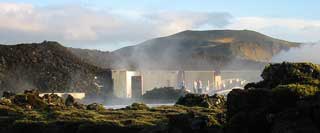
As we neared the Blue Lagoon (visible as a giant cloud of steam halfway up the ridgeline) Ashcroft explained that there are three things cheap in Iceland - water, air, and electricity (though I bet you could also get a good price on igneous rock). To make power in Iceland, you just have to dig a hole, stop when you hit superheated sea water, and build a geothermal plant on top. The Blue Lagoon, fancy name nothwithstanding, is basically a repurposed runoff pond for one such geothermal plant. The pressurized water comes out of the ground at 240 degrees Centigrade, but is cooled to a more endurable 38 degrees before reaching the bathing area, to avoid poaching the patrons.
The lagoon has a funny origin. When the power plant was built, water was just dumped onto the ground, where it was supposed to percolate back down through the porous lava. But instead it formed a little hot lake, which quickly became an illicit swimming spot for local teens. When teens with skin problems started suddenly being cured of psoriasis and other serious afflictions, it naturally attracted some attention. After much interrogation, one of the teens owned up to taking nighttime swims in the runoff pond, and a great spa was born. The water was mildly curative, full of beneficial minerals and blue-green algae, and it probably didn't hurt that the site was ten miles from the international airport.
The spa complex is nicely built - as you approach it, you see enormous clouds of steam billowing far into the air, much like they do from Middlebury College's ridiculously ill-designed Center for the Arts, which burns through $800,000 worth of heating oil every winter (oops - that's confidential!).
The approach to the spa is through a kind of deep trench through the lava, which is foamy and dark and looks very lethal, making you reflect uneasily on the recentness of its arrival. The spa itself is spacious and full of nice thoughtful touches - you can rent a swimsuit (because who thinks to pack one, to Iceland?) and you are given a little waterproof bracelet with a tag on it that lets you in the main swimming area and also serves as an electronic key for whatever locker you choose to leave your stuff in. The locker rooms even have hair dryers, although none of the men I was with wanted to look like a sissy and actually use one.
After changing and showering, you walk out into the freezing cold and yelp your way into the enormous pool of blue water, which is four feet deep and covers at least an acre. It's like being in a hot bath, assuming your tub is lined with volcanic rock and is full of Norwegians. The water is an opaque sort of turquoise and quite salty. A lotion-like substance precipitates out of the water in places, and it is sold by the spa staff as an expensive cosmetic cream. To me, it felt more like pond muck back in summer camp, squeezed between my toes. But I notice that my feet have been lovely ever since.
Once you leave the spa, you walk straight into a restaurant. The atmosphere is convival, Norwegians notwithstanding, and the room even lets in great portions of sunlight (stingily administered through a notch between two volanoes on the horizon).
I soaked for an hour, until my hands had turned raisin-like with wrinkles, and then stood for another ten minutes under the waterfall, where it felt like hot rocks were being dropped on my shoulders. Going back to the airport, I was a transformed man. Clean, relaxed, smelling very faintly of volcanic sulfur, I had a quick meal of square meat on dark bread and then fell asleep at the gate, waking just long enough to get myself to the Netherlands.
If you are flying to Europe for any reason, you would be silly not to check out Iceland Air. Just like Vegas, where they make layovers longer to maximize passenger gambling, Iceland Air tries to give you long enough between planes to zip over to the Blue Lagoon (my nine-hour layover was an unusually long exception), and the tour staff is used to whisking passengers there and back between flights. It costs a whopping $25, on top of the $304 (all taxes included) I paid for a round trip ticket between Boston and Amsterdam. Instead of spending eight hours in a plane, you can have two shorter flights with a hot bath in between, you can see Iceland, and you can arrive in Europe in the early evening, just in time to check in for a good night's sleep.
Mmm... sleep...
[link]My own race day starts at half past five in the morning, on a sofa somewhere in midtown Manhattan. My girlfriend's brother has graciously let me stay in his immaculate 42nd street apartment, and now his little calico cat is licking my elbow, and the alarm clock is blaring to wake me up.
I have caused a storm of controversy in my girlfriend's family with my radical theory that carbo-loading and restful sleep two nights before the marathon are much more important than what happens on the eve of the race. I am about to put the theory to the test - I'm fueled up on bad Chinese food and my night has consisted of tiny catnaps, interspersed with worry.
To prevent an anxiety meltdown, I have laid everything out the night before: battered shoes with Official ChampionChip Marathon RF tag securely attached, running shirt with Official Marathon Race Number securely pinned, running shorts with $20 in cab fare tucked into a secret pocket (I'm putting pecunia non olet to the test). Over this goes an old ratty set of sweats that I will abandon at the starting line. I step out into the New York morning with my Official Marathon Plastic Bag, where I have put my pre-marathon essentials:
The cookies and Gatorade are for devouring. The Tom Clancy novel is to fill the time - I've picked a book that's good for mindless reading, yet annoying enough to jettison without regret when it comes time to start the race.
People who say that running a marathon is purely mental are, in my opinion, talking nonsense. But it's true that the race tends to bring out all kinds of mental challenges. On the morning of the race, the challenge is controlling anxiety. It occurs to me that I've gone too far in the anxiety direction as I walk out of the apartment building. I had spent much of the night worrying that I wouldn't be able to find the bus pickup point, but now I see hundreds of people in track suits, all carrying Official Marathon Plastic Bags, converging on a spot a few blocks west of me. Also, the mile-long string of chartered buses idling along fifth avenue is hard to miss, as are the dozens of flare-carrying volunteers and the horde of runners standing meekly in line for each bus.
"Smile!" yells one of the volunteers. She's got a megaphone, and it sounds vaguely threatening. "None of you are smiling! It's gonna be a great race."
To a first approximation, the NYC Marathon is all about standing in line. There's the line to pick up a race number, the line for the chemical toilets, the line to get out of Central Park. The only unusual thing is that, for four or five hours in the middle, the line moves really quickly.
Serious queueing up had started the day before, when I had accidentally tried to cut the registration queue at the Javits convention center, only to be courteously directed to the back of a line that wrapped all the way around the block, down to the water, and around the corner, something approaching a quarter of a mile. Registration was also my first brush with the marathon volunteers, who somehow combine ruthless efficiency with the sunniest cheerfulness. Imagine a Switzerland populated by Mormons - yet somehow all these people come from New York!
The buses whisk us from Fifth Avenue to a staging area just outside of the Verrazano Narrows Bridge. Earlier buses have arranged themselves on the toll plaza to form a natural corral shape (the level of organization behind the marathon is terrifying), funneling arriving runners into Fort Wadsworth. Swiss Mormon volunteers are already there, at 6:50 AM, to cheer us on. They look to be high school kids. I don't think the Last Trump could have gotten me out of bed at 6:00 AM on a Sunday back in high school.
The sun is just popping over the horizon as I walk through the gates - it's cheery and red, playing innocent. The forecast has been for clouds, but the morning skies are clear and temperatures are threatening to climb into the seventies. For marathon running, that's a scorcher. I cheerfully add it to the list of things I have no control over.
The next three hours pass quietly. More and more people are arriving - I start to see costumes and flags here and there. There's a series of bands playing, but no one is really paying attention to them. People huddle over by the giant tent that says "BAGELS", or the one that says "COFFEE" - others stretch on the lawn. The line for the chemical toilets reaches horrifying proportions; someone finally knocks down a bit of storm fence and the impatient and shameless go off to pee in the woods.
As the starting time approaches, we get up and go to our assembly points. I abandon my sweats and the irritating novel to join the crowd. I can see water bottles flying to the left and right. The crowd starts moving forward, and we pass back out through the even longer bus corrall, the same high school kids cheering as hard as they can (God, they are wonderful). Soon we're almost at the bridge, waiting for the start. A woman in front of me is explaining how the transmitter on her shoe talks to her wrist, so she always knows her exact pace. We are all packed in together like pickles in a barrel.
Mile 0
BOOM! There's a loud cannon blast from the base of the bridge, and everyone gives a cheer. I can see the first runners moving a few hundred feet ahead, and then my own sector breaks into a slow jog, with clothing and water bottles hurtling off overhead. As we get close to the actual start line,there's a sound truck with a bunch of cops sitting on it. The truck is blaring "New York, New York", and the cops and runners all cheer like crazy. I've never felt so pumped up in my life.
Running onto the Verrazano Narrows Bridge, I can hear a delighted, surprised whoop up ahead, and it moves backwards through the crowd towards me at the same speed we are running. Suddenly I step onto the bridge and start whooping myself - the bridge is bouncing up and down beneath our feet, it feels like we're running on a trampoline or a huge, molasses-filled waterbed. Turns out these suspension bridges really are just dangling there.
We are running as one big mass - there is no lateral room for movement, and no way to set your own pace. A few desperate runners have hopped up on the curbs or the median divider, trying to run at speed. Some male runners are lining up along the guard rail for a ceremonial salute, dribbling used Gatorade onto the enormous container ships passing underneath.
Mile 1
It takes us 13 minutes to run the first mile, and we're still on the bridge. That's slower than a brisk walk. A man in a full-body Superman outfit is standing motionless on the three-foot-high concrete divider, pointing in the direction of Brooklyn in a Superman pose. We all cheer again. Up ahead I see a big hand-lettered sign reading 'Yo Brooklyn!', and there's the faintest sound of cheering from down below.
Mile 4
We're on Fourth Avenue, Brooklyn, surrounded by mobs of people. It's still hard to run at a comfortable pace - we reach the first water table and I almost fall over the runners in front of me, all of whom stop. Little kids are leaning out from the sidewalk for high-fives, there's a school band playing somewhere.
Mile 6
I spot an bookish but attractive woman with a big sign:
MARK![photo of Mark, a bookish but attractive man]
4 hrs = SEX!
I wonder if they're a couple, or if this is a surprise motivational treat.
Mile 12
We're in Green Point, Brooklyn - one of the few places outside Poland and Chicago where a Pole can spend his whole life without having to learn a second language. These are my people! I wait until I see a group of Slavic faces and yell "Czy sa tu jacys Polacy? (Any Poles here?)" The crowd cheers! I am intoxicated with my powers; I spend the next mile stirring up Green Point, and the rest of the race calling out Viva Mexico! after discovering that Mexican spectators go even more apeshit than my own countrymen. I try Viva Mexico! out on one group of brown faces and a mariachi band strikes up! Huge Mexican flags pop out of nowhere, there is mad cheering. Mexico has had some major marathon heroes in recent years, I don't know if the intense New York fans are a cause or result.
Mile 13
Halfway there! A race organizer with a megaphone tells us we're on a 4:20 pace. Not bad, considering the forced slowdown at the beginning. I can feel my legs working, but I'm not quite tired yet.
Mile 15
Tired. We're on the 59th street bridge, crossing into Mahnattan. Unlike the Verrazano Narrows bridge, this part of the course is on the lower level, so the impression is of an infinitely long, metal-ribbed tunnel going uphill. It's an agonizing climb, up and up, everyone around me is staggering. A group of runners comes up from behind me, singing:
Slow down, you move too fast
You've got to make the morning last
Just kickin' down the cobblestones ...
And then everyone joins in:
Looking for fun and feeling Groovy.
The European runners in front of me exchange a worried, trapped look. They are stuck on a bridge with hundreds of natives who have obviously just gone loco.
Mile 16
Authorities on the New York marathon all tell you that you slowly begin to hear an enormous roar as you descend into Manhattan. That may be true if you're running a 3:00 marathon pace, but on 4:20 the effect is much more subdued. I think back to last year, when I yelled myself hoarse, and commiserate with the crowd. They are maintaining huge enthusiasm, but a lot of them have no noise left to give.
I round the bend coming off of the bridge and there is my girlfriend, ready for the Krispy Kreme handoff. She has picked up a Boston Creme and a Chocolate Frosted, whose job it is to give me enough sugar to reach mile 26. I kiss her and wave the bag triumphantly at the crowd, yelling "Krispy Kreme!", but they don't seem impressed. It will take me three miles to eat the chocolate donut, in between trying to breathe. The Boston Creme will be abandoned in the Bronx.
It is hot and a lot of people are walking. We come to a sponge station and I wipe my forehead - I can taste the salt from my face, I've been sweating like crazy for nearly three hours.
Mile 19
We're at 115th street, and the crowd has thinned considerably. My legs are much more tired than I expected, and getting stiff - I stop at a water stand, and walk a block before running again. The next five miles will be walk-and-run, trying not to let my legs seize up like they crave to do. A man with a big synthesizer is playing some easy listening jazz number. I resist the urge to trample him (must conserve energy). Who the f*** plays elevator music to motivate tired runners?
Mile 20
Crossing over the Willis Avenue bridge into the Bronx. Sections of this bridge are made of iron latticework, so it's been covered with a kind of red carpet that gives this part of the race a ceremonial feel. We're all crazy tired, and it's a long climb into the Bronx. I see a runner in a shirt that says "Italia" stagger off to the right, missing the electronic mat that's supposed to measure our 20-mile split time - an automatic disqualification. "Hey, Italia!" I yell. "ITALIA!" He looks back, and I point at the mat, gesturing for him to turn around and run over it. He stares for a minute and then understands, looking mortified.
Immediately over the bridge stands a big mustachioed cop with sunglasses, straight out of central casting.
"Welcome to the Bronx, ladies and gentlemen!" he yells. "Do you know what people do when they come into the Bronx?"
"What?" we all say.
"THEY RUN OUT OF THE BRONX!"
Message received.
We're running through a black neighborhood, and some of the locals are blasting hip-hop. This is an infinite improvement over Smooth Jazz man. Near the Bronx-Manhattan bridge, a big guy in dreadlocks with a live mike is improvising reggae riffs about passing runners.
Mile 21
A male runner is leaning forward exhausted against a lamppost. He has two brown lines of blood down the front of shirt. White cotton shirts should come with a label: "WARNING: Wearing a natural-fabric T-shirt for runs exceeding ten miles may result in severe nipple damage". I cringe about as badly as you are cringing now - I've been down this road myself, before a nasty training run convinced me to shell out for a proper running shirt.
My legs are scaring me - when I slow to a walk, the fronts of my thighs feel like they're about to seize up in a massive cramp. I have had one cramp in all my training runs - felt my calf suddenly seize up into a knot, pain like I had never experienced. I'm afraid that cramps in my thighs will make it too painful to walk, and take me out of the race . I pass a woman yelling "Candy! Salt! Salt or candy!" I ask for salt and get a large pinch of Morton's finest. It's too strong to eat straight. Another woman hands me a water bottle and I dump the salt right in - the best drink I've ever tasted.
Mile 23
Fifth avenue, with Central Park on the right. The crowd is getting massive again; for some reason I am resenting them a little bit. They just want to see the train wreck that is an amateur runner after 23 miles.
Remembering Nipple Man, I gratefully accept a Vaseline-coated tongue depressor from a medical volunteer, and grease myself up. Running is a beautiful sport.
Mile 26
At this point I am just running towards the light.
FINISH
Everyone smiles and raises their arms as they cross the finish line. There are photographers up above who are taking our picture; we'll be able to buy a print after the race, if we like. Clever entrepreneurship or crass capitalism? After 26.2 miles of running, I could not care less what it is. I raise my arms and run over the finish line like a good sheep.
Suddenly the whole pack is walking again, just like we were right before the start of the race. A line of very kind volunteers is standing there with medals, putting one around each runner's neck. Another set of volunteers hands out thin aluminized mylar blankets, and suddenly I am standing in a forest of silver and yellow ING Marathon logos, with a faint rustling all around. A third set of volunteers hands out little goodie bags (contents: water, apple, banana, raisins, and 'high protein energy bar', presumably to replace all the protein we lost when our calves fell off at mile 23). All this time we are moving slowly up Central Park, between a fence and a line of UPS trucks where runners can pick up their belongings. A number of people start to make calls on their cellphones. There's a number of people lying on the lawn, being tended to by medical volunteers. A woman to my right is barfing up a few quarts of water. I feel strangely teary-eyed, but remember that weird emotions are common right after the race, and eat my banana in peace.
It takes the better part of an hour to shuffle out of the park, and all the way up to the Blue reunion area on 79th street. I find my girlfriend near the 'C' sign, next to a pack of other Poles all dressed in red. I get flowers! I have finished!
The next hour consists of me and five thousand other runners with their families walking west, trying to find a cab. We get picked up by a Brazilian driver who can't stop congratulating me and asking about the race, unfortunately in completely inaudible tones. He tells a long story about his own running past, but I can barely hear any of it. I smell like a hamper full of gym socks. This is the brief golden hour during which I believe P. Diddy has actually dropped out of the race. My girlfriend has not seen him from her own vantage point, and rumors are flying that he got hit hard in the race and had to drop out. I feel vindicated and secure - my entire race strategy depended on being able to out-endure Diddy, and it looks like I've succeeded. I eat the filling out of a Reese's cup, calling blessings on the head of whoever decided to make peanut butter cups extra salty.
4:30 PM - Showertime. This is the part of the race where you discover exactly where you got badly chafed. You discover this because the shower washes salt from your body into the wounds. The apartment fills with my screams.
5:00 PM - A brief, half-hour nap. There is no position in which my legs do not hurt. I must still be a little salty because the cat is in a licking frenzy at my elbow. I feel something heavy and uncomfortable settle on my head. It my girlfriend, using me as a pillow.
5:30 PM - My girlfriend, her brother, and both cats are all asleep. Apparently my fatigue has permeated the room and knocked out the unprepared. I sneak outside with the laptop to find a wireless network, and read the crushing P. Diddy news. It seems like half the internet has covered my defeat in real time. For a second I am embarrassed, but then I come to my senses. I've spent the entire day surrounded in goodwill - from the thousands of volunteers and organizers who arranged the amazing spectacle, to the millions of people who cheered us on, to all of the Good Samaritans who handed me bananas, oranges, water, salt - things they had paid for and brought out to the race for the benefit of total strangers. And now I see that online friends have been following my progress, sending email, cheering me against the machine that is P. Diddy.
It's the kind of display I don't know how to recover from. I don't know how better to see the best of New York City than through this race. I'm overwhelmed, happy, tired, unable to climb stairs, and hungry like the wolf. It is a very, very good feeling.
Thank you to everybody who sent in encouragement, or went out to see the race this weekend and cheered us all on. I owe New York City big.
[link]| << October 2003 | ^ 2003 | December 2003 >> |
Frequent Topics
china (13)Greatest Hits
Every Damn Thing
Your Host
Maciej Cegłowski
maciej @ ceglowski.com
Less Idle
Mimi Smartypants
The best writer I know
Jeweled Platypus
Britta gives me hope
A Shout Out To My Pepys
Ignatz takes it away
Scrubbles
Posters, books, design, bric-a-brac. Smart writing
Duck For Cover
Marrije reads so you don't have to
Language Hat
Always interesting language geekery
Eyeteeth
Eyeteeth is bound for writing glory
Threat
Please ask permission before reprinting full-text posts or I will crush you